
Building Tread Lightly
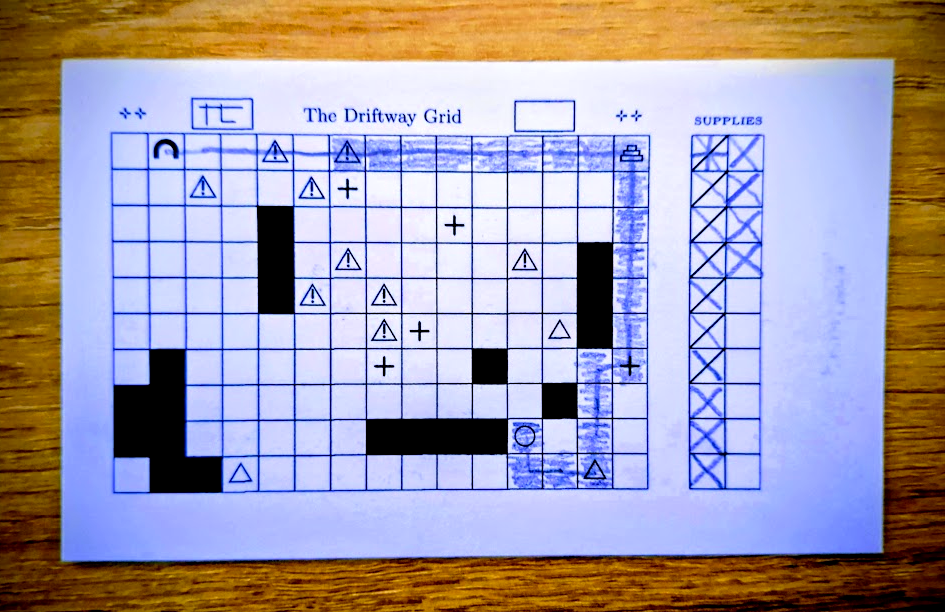
I've spent some time recently building microgames - not as an exercise in minimalistic aestheticism, but as a way of putting my work under tight constraints. With very little space and almost no components, there's nowhere for a design to hide and no room for bloat.
Either the mechanics carry the experience, or they don't.
Tread Lightly was the first result of that experiment.
The Feeling
It started with a feeling I was trying to evoke rather than a set of mechanics.
I wanted the sense of moving through a space actively failing behind you - where each step makes retreat harder, and the traces of your previous decisions leave marks even as they stop being useful.
That ruled out anything resembling a scripted narrative or a story to uncover. Instead, I focused on using the limited scope to provide just enough structure for players to generate their own narrative through play. Meaning emerges from the accumulation of decisions and their consequences over time.
Traces
One of the earliest decisions was that the game state should never fully reset during play.
The map changes, paths disappear, options close, stepping backwards becomes impossible. When space is used up, it stays used up. When a route is cut off, it remains cut off. What you've done stays visible in the layout you leave behind.
This turns the board into a record rather than a snapshot. It shows where you've been, what you've lost access to, and which possibilities you've neglected along the way.
I chose this because it gives narrative weight without explicit storytelling. By the end of a session, the final shape of the map reflects how you played and the risks you were willing to accept.
Movement
All this means that movement should feel like a commitment rather than a calculation.
Moving forward is necessary, but not free. Each step narrows future options, cuts off routes, and contributes to the collapse of the space behind you. Tread Lightly doesn't reward efficient pathing so much as force decisions about which possibilities you're willing to abandon.
I deliberately avoided mechanics that would let players recover lost ground or undo earlier choices. Retreat is technically possible, but it becomes less viable over time. The pressure comes from knowing that every move makes the space smaller, even if it's sensible in the moment.
Playtesting showed that this worked, but also revealed a problem.
Some players became overly cautious. Faced with irreversible loss and inevitable collapse, play slowed and narrowed, with each move something to be optimised rather than committed to. The collapsing space created tension, but could also encourage paralysis.
I made changes to the procedural algorithm and added the Temple mechanic, in response to this specific reaction. The Temple introduces a deliberate temptation: towards the latter half of the path it promises rewards for the risk of stepping away from the ideal route. Moving towards a Temple carries a significant prize, but almost always carries the risk of accelerating collapse.
Unresolved
There are parts of Tread Lightly that I could have smoothed more, but chose not to.
In particular I resisted the urge to add more recovery or safety valves as the space collapses. It would have been easy to give players more ways to mitigate loss, but doing that would have shifted the feel from flight to optimisation. I wanted to keep the pressure intact, even if that makes some outcomes feel harsh.
I also chose not to over-explain the intent. Most of what Tread Lightly is trying to do is carried by the system rather than framing or flavour text. That leaves some ambiguity in early play, but it preserves the space for players to project their own story onto what's happening.
Those were conscious decisions rather than open problems. The game could be pushed further in either direction, but I'm currently comfortable with where those edges sit.